Become Master in Digital Marketing!
Enroll Now

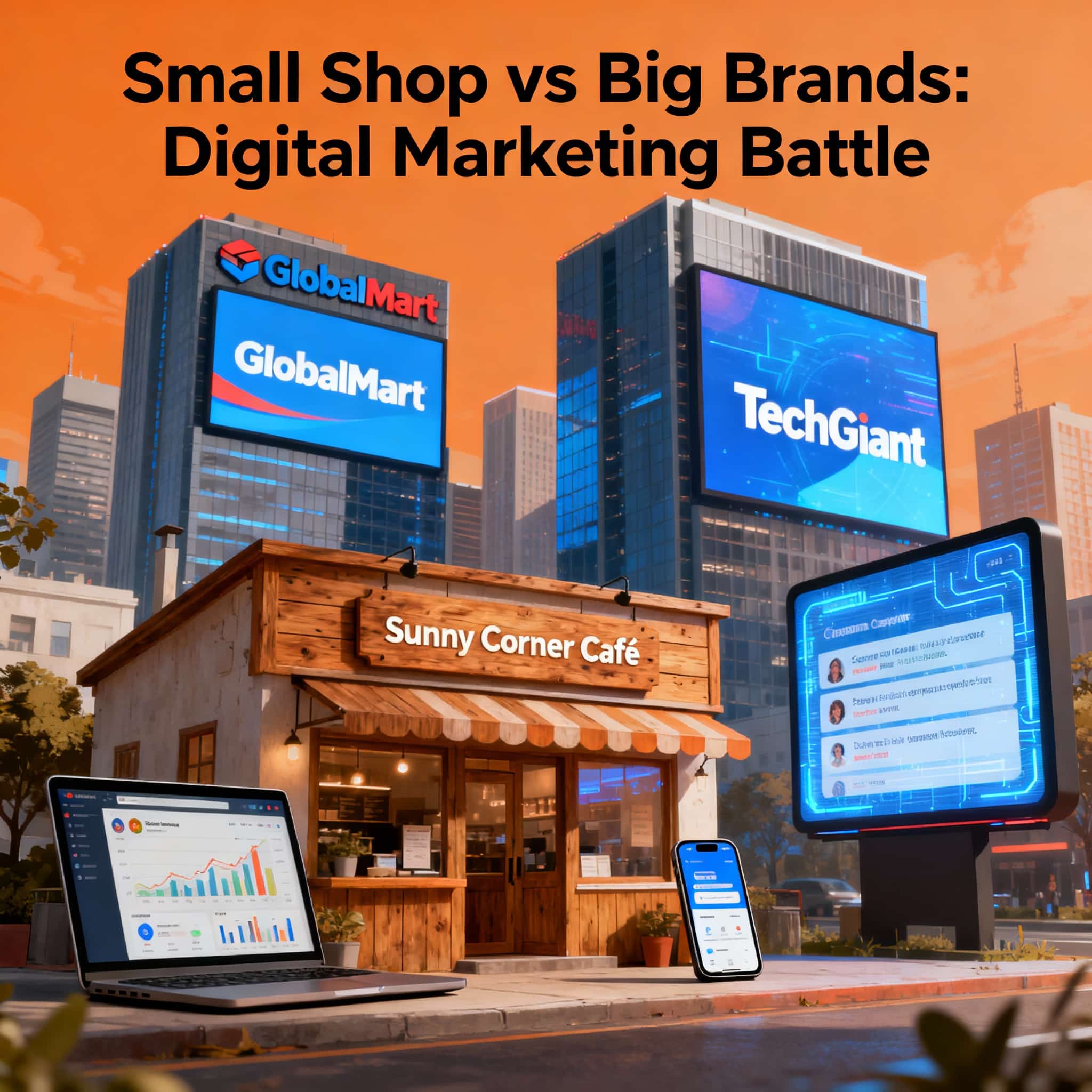
The playing field isn’t as uneven as you might think. While major corporations throw around marketing budgets that could fund small towns, smart small businesses are discovering something remarkable: digital marketing has become the great equalizer. In fact, 85% of small businesses now use digital marketing to reach their target audience, and they’re seeing results that would make Fortune 500 executives jealous.
The secret isn’t outspending the giants. It’s outsmarting them. Small businesses that embrace strategic digital marketing can achieve a 28% higher return on investment compared to traditional marketing methods. This isn’t just theoretical success; it’s happening right now, transforming neighborhood shops into national players and turning passionate entrepreneurs into household names.
David vs. Goliath Reality of Modern Marketing
Let’s be honest about what you’re up against. Big brands have deep pockets, dedicated marketing departments, and name recognition that took decades to build. They dominate search results, flood social media feeds, and seem to have unlimited resources for flashy campaigns.
But here’s what they don’t have: the ability to pivot in 24 hours instead of 24 weeks. They can’t know their customers by name or respond to local events with genuine authenticity. When Dollar Shave Club launched their game-changing company with just a $4,500 YouTube video, they weren’t competing with Gillette’s hundred-million-dollar budget. They were competing with something far more valuable: relevance and personality.
Dollar Shave Club identified what their giant competitor was missing. Gillette’s razors cost $20-25 for a four-pack and came loaded with unnecessary features that most people didn’t want or need. Meanwhile, their advertising relied on expensive celebrity endorsements that ultimately just drove up product prices for consumers. The small startup offered quality razors for $1 per month delivered directly to customers, bypassing retail markup entirely.
The results speak volumes about the power of smart digital marketing over big budgets. Between 2010 and 2016, Gillette’s U.S. market share plummeted from 70% to 54% while Dollar Shave Club built a subscriber base of 3.5 million people. In 2016, Unilever acquired the startup for $1 billion, proving that digital-first strategies can create massive value quickly.
Your Hidden Competitive Advantages
Small businesses possess unique strengths that big corporations spend millions trying to replicate. Understanding these advantages is crucial for building an effective digital marketing strategy that plays to your natural strengths rather than trying to mimic what the big players do.
Speed and Agility Transform Everything
While corporate marketing teams schedule meetings to discuss scheduling meetings, you can spot a trend on TikTok in the morning and launch a campaign by lunch. This agility is your superpower. When a local event happens, a seasonal trend emerges, or customer feedback suggests a new direction, you can pivot immediately. In 2025, 54% of small business leaders feel confident navigating market changes specifically because they’re using AI tools, automation, and agile workflows.
Mixture, the Chinese bubble tea chain, exemplifies this advantage perfectly. They’ve become the world’s largest food and beverage chain by number of outlets, surpassing both Starbucks and McDonald’s. How? By offering affordable treats like $1.10 brown sugar milk tea and 50-cent ice cream, pricing that undercuts McDonald’s while maintaining quality. Their localized approach and quick adaptation to regional preferences allowed them to open over 45,000 stores globally, with franchises operating at the community level.
Personal Connections Create Unbreakable Loyalty
Big brands dream of the relationships you can build naturally. When customers tag you on social media, you can respond personally instead of through a corporate social media manager. When someone has a problem, they can speak directly to the owner instead of navigating phone trees and ticket systems. According to 2025 research, 78% of marketers now recognize that social media has become consumers’ preferred customer service channel.
This personal touch translates directly into business results. Studies show that micro-influencers with smaller, more engaged audiences deliver up to $18 in returns for every dollar spent, compared to expensive celebrity partnerships that big brands typically pursue. The reason is simple: authenticity creates trust, and trust drives purchasing decisions.
Local Relevance Beats National Recognition
While big brands struggle to appear locally relevant. You know which high school just won the championship, when the farmer’s market changes location, and what your community cares about most. This local knowledge becomes powerful digital marketing content that resonates far more than generic corporate messaging.
Local SEO statistics prove this advantage: 76% of people who search for local businesses visit a store within 24 hours. Even more impressive, 46% of all Google searches are local in nature. When someone searches for “best coffee shop near me,” your authentic local presence often outweighs the brand recognition of national chains.
Success in digital marketing isn’t about having the biggest budget. It’s about using the right strategies in the right way. Here are the tactical approaches that consistently help small businesses compete with and often outperform much larger competitors.
Content Marketing: Your 24/7 Sales Representative
Content marketing gives small businesses a 300% higher lead generation rate compared to traditional advertising methods, and it costs 62% less than outbound marketing. But the real power lies in how you approach it differently than big brands. In 2025, the emphasis has shifted even more toward authentic, relatable content over polished corporate messaging.
Instead of creating generic, committee-approved content, you can share behind-the-scenes stories, founder insights, and real customer experiences. A local bakery that shares the story behind their family recipes, shows the early morning prep work, and features regular customers creates content that no corporate bakery chain can replicate. Blue Sky Bakery, a regional chain, exemplified this approach by sharing mouthwatering images of their daily baking process, featuring customer testimonials, and creating user-generated content campaigns. Within months, they saw notable increases in both online orders and foot traffic, particularly during promotional campaigns.
Social Media: Where Authenticity Wins
Social media platforms have become the ultimate small business marketing tool because they reward engagement over ad spend. The algorithm doesn’t care about your marketing budget; it cares about how people respond to your content.
TikTok has become particularly powerful for small businesses. With 39% of small to mid-size businesses saying the platform is critical to their existence, and 69% reporting increased sales directly attributed to their TikTok presence, the platform represents a genuine opportunity for small businesses to compete. The platform’s algorithm actively promotes engaging content regardless of follower count, meaning a well-crafted video from a local restaurant can reach millions of viewers organically.
For younger audiences, TikTok is now being used as a search engine, with 77% of Gen Z TikTok users using the platform for product discovery. Meanwhile, traditional platforms remain powerful: Facebook still dominates with 91% of B2C businesses using it, and Instagram captures engagement from 69% of users who say they find the most engaging brand content there.
The key is consistency and authenticity rather than perfection. Regular posting, engaging with comments, and creating content that feels genuine consistently outperforms polished corporate content that lacks personality. Many small businesses report an average ROI of around $5 for every dollar spent on social advertising when targeting middle-of-funnel customers.
Local SEO: Your Geographic Advantage
Local SEO represents one of the most significant advantages small businesses have over big brands. While corporations struggle to optimize for thousands of locations, you can focus intensively on your specific market area. Local SEO has emerged as one of the top small business marketing trends for 2025, particularly with the rise of hyper local marketing.
Optimize your Google Business Profile completely, encourage customer reviews actively, and create location-specific content regularly. Many franchise locations of major brands have poorly maintained local SEO because corporate oversight creates inconsistencies and delays.
Simple tactics like using neighborhood-specific keywords, posting about local events, and maintaining accurate business information can help you outrank corporate competitors in local searches. Remember, someone searching for “pizza delivery downtown” cares more about proximity and quality than brand recognition.
Email Marketing Effect
Email marketing delivers an astounding 3,600% return on investment, generating $36 for every dollar spent. This makes it the most cost-effective digital marketing channel available, and small businesses can use it more effectively than large corporations. Email marketing remains one of the most affordable and effective ways to reach middle-of-the-funnel prospects in 2025.
Your email list becomes a direct line to customers without algorithmic interference or advertising costs. You can send personal updates, exclusive offers, and behind-the-scenes content that builds real relationships. Unlike big brands that rely on automated sequences and generic messaging, you can write emails that sound like they come from a real person because they do.
Micro-Influencer Partnerships: Authentic Advocacy
Instead of competing for expensive celebrity endorsements, partner with micro-influencers who align with your brand values and actually use your products. These collaborations often feel more authentic because they are more authentic. In 2025, 53% of small businesses are partnering with micro-influencers for targeted campaigns.
Their audiences trust their recommendations because the relationship feels personal rather than purely transactional.
The key is finding influencers who genuinely connect with your brand rather than simply choosing based on follower count. A local fitness influencer who actually trains at your gym will create more compelling content than a national fitness celebrity who has never visited your location.
Digital Marketing: The Scoop for Main Street for Your Small Business
The digital landscape is evolving rapidly, and smart small businesses are staying ahead of the curve by embracing emerging trends.
AI Age and Automation
One of the biggest game-changers in 2025 is the democratization of AI tools. Currently, 23% of U.S. small businesses use AI chatbots and automation tools to handle customer inquiries, schedule appointments, and personalize marketing messages. These tools, many of which are available for free or at low cost, allow small businesses to provide customer service that rivals what big brands offer.
AI-powered tools can analyze customer behavior, predict purchasing patterns, and automate repetitive tasks, freeing you to focus on strategy and creativity. The best part? These tools are now accessible to businesses of all sizes, not just corporations with massive IT departments.
Social Commerce is Exploding
Social commerce is growing three times faster than traditional e-commerce, with projections hitting $1.2 trillion in 2025. This means selling directly on social platforms like Instagram, Facebook, and TikTok is becoming the new norm. Small businesses that master social commerce can compete directly with big brands by creating seamless shopping experiences right where customers already spend their time.
Video Content Dominates
In 2025, 89% of businesses use video marketing, and 68% of marketers who don’t currently use video plan to start. Short-form video content continues to dominate, with platforms prioritizing quick, engaging clips that entertain or inform audiences. Live streams also offer powerful opportunities to connect with and build community through real-time interaction.
Sustainability Matters More Than Ever
A major shift in consumer values shows that two-thirds of American shoppers are now making purchasing decisions based on sustainability. Small businesses that build their operations around eco-friendly practices and support local communities earn more customer trust and loyalty. Consumers are even willing to pay premium prices for products from businesses that align with their values. This represents a significant advantage for small businesses that can authentically demonstrate their commitment to sustainability.
Innovation Through Limitation
Your budget constraints force creativity in ways that unlimited resources cannot. This limitation often leads to more innovative and effective marketing approaches than what big brands produce with their massive budgets.
Guerrilla Marketing Goes Digital
Digital guerrilla marketing tactics can create massive impact with minimal investment. A cleverly timed tweet, a humorous response to trending topics, or a creative video can generate more engagement than expensive ad campaigns.
When big brands try to be spontaneous, it usually feels forced because it has to go through approval processes. Your genuine, in-the-moment responses to current events or customer interactions can feel authentic because they are authentic.
Building Community
Instead of trying to reach everyone, focus on building a devoted community around your brand. A thousand engaged followers who genuinely care about your business are more valuable than ten thousand passive followers who barely notice your posts. In 2025, consumers are connecting with brands on social media more than ever, with nearly half (48%) increasing their engagement in the last six months alone. Engage in real conversations, ask for feedback, and make your customers feel like they’re part of something special. Big brands struggle with this because scale makes personalization difficult and expensive.
Data-Driven Decisions Without Big Data Complexity
You don’t need expensive analytics platforms to make smart decisions. Free tools like Google Analytics, social media insights, and customer feedback can provide all the data you need to optimize your marketing efforts. In 2025, there will be more free and budget-friendly marketing tools available than ever before, including Canva for design, Mailchimp for email marketing, Google Business Profile for local SEO, and Hootsuite for social media management.
The advantage of a smaller scale is that you can actually pay attention to the details that get lost in corporate reporting. You can notice which customers engage most with specific types of content, which local events drive the most business, and which marketing messages resonate most strongly.
Free and Affordable Tools for Small Businesses in 2025
Budget-conscious doesn’t mean limited options. Here are powerful tools that won’t break the bank:
Google Analytics and Google Business Profile provide comprehensive data about your website visitors and local search performance, completely free. Canva offers professional-quality graphic design capabilities with a generous free tier. Mailchimp allows you to build and manage email campaigns for free up to 500 contacts. Buffer or Hootsuite help you schedule and manage social media posts across multiple platforms. Ubersuggest provides keyword research and SEO insights at a fraction of the cost of premium tools.
These tools give small businesses enterprise-level capabilities without enterprise-level costs, truly leveling the playing field.
Measuring Success and Scaling Smart
Success in digital marketing isn’t just about implementation; it’s about continuous improvement based on real results. Small businesses can track and optimize their marketing efforts more effectively than large corporations because they can focus on metrics that directly impact their specific business goals.
Focus on Revenue-Driving Metrics
While big brands obsess over vanity metrics like impressions and reach, focus on metrics that directly correlate with business growth: conversion rates, customer lifetime value, cost per acquisition, and return on ad spend. In 2025, the most successful small businesses track customer acquisition cost (CAC), return on ad spend (ROAS), email open and click rates, and engagement rates.
Your smaller scale makes it easier to track these meaningful metrics and connect marketing activities to actual revenue. You can often tell immediately which marketing efforts are working because you can see the direct impact on sales and customer inquiries.
Reinvest Success Strategically
As your digital marketing efforts start generating positive returns, reinvest those profits strategically rather than scaling everything at once. Double down on what’s working best and gradually test new channels and tactics. According to industry benchmarks, small businesses typically spend 7-10% of their revenue on marketing annually.
This methodical approach to growth allows you to maintain the personal touch and authenticity that made you successful in the first place while expanding your reach and impact systematically.
The Future is Bright for Small Businesses
The digital marketing landscape continues to evolve rapidly, creating new opportunities for small businesses to compete effectively with major brands. In 2025, the ambition of small business owners is clear. Fueled by widespread financial optimism, over three-quarters (78%) are focused on growth, leading more than 60% of small businesses worldwide to lay out plans for expansion.
By focusing on your natural advantages, implementing proven strategies consistently, and maintaining the authentic relationships that big brands can’t replicate, you can build a thriving business that competes successfully in any market.
Remember, the goal isn’t to become a big brand. It’s to become a profitable, sustainable business that serves your customers better than the big brands ever could. Digital marketing provides the tools; your authenticity, agility, and customer focus provide the competitive advantage that no budget can buy.
The data proves it: small businesses embracing digital marketing are not just surviving but thriving in 2025.
With 65.3% of small businesses globally profitable and strategic digital marketing delivering measurable returns, the question isn’t whether small businesses can compete with big brands.
The question is: are you ready to outsmart them?
Citations:
- https://www.sec.gov/Archives/edgar/data/1990625/0001990625-23-000001-index.htm
- https://www.hubspot.com/marketing-statistics
- https://www.seo.com/blog/digital-marketing-statistics/
- https://www.wordstream.com/blog/ws/2022/04/19/digital-marketing-statistics
- https://www.wix.com/blog/small-business-marketing-statistics
- https://www.taboola.com/marketing-hub/small-business-marketing-trends/
- https://bizplanr.ai/blog/small-business-statistics
- https://digitalmarketinginstitute.com/blog/digital-marketing-trends-2025
- https://www.salesforce.com/marketing/marketing-statistics/
- https://digirivera.com/how-small-businesses-can-grow-using-digital-marketing-in-2025/
- https://journals.vilniustech.lt/index.php/BTP/article/view/21233
- https://www.wr-publishing.org/index.php/ijarbm/article/view/180
- https://journals.e-palli.com/home/index.php/ajebi/article/view/4438
- https://openjournal.unpam.ac.id/index.php/EBIC/article/view/50941
- https://sijdeb.unsri.ac.id/index.php/SIJDEB/article/view/775
- https://journal.ipb.ac.id/index.php/ijbe/article/view/60793
- https://ijisem.com/journal/index.php/ijisem/article/view/219
- https://transpublika.co.id/ojs/index.php/JEKOMBITAL/article/view/932
- https://www.scirp.org/journal/paperinformation?paperid=145782
- https://journal.faibillfath.ac.id/index.php/taawun/article/view/907
- https://www.buzzboard.ai/is-digital-marketing-worth-it-unveiling-the-roi-for-small-businesses/
- https://omrdigital.com/how-small-businesses-can-compete-with-big-brands-online/
- https://uptickmarketing.com/blog/strategies-to-compete-with-big-brands/
- https://thethinkschool.com/market-disruption-analysis-gillette-vs-dollar-shave-club/
- https://economictimes.com/news/international/business/make-room-starbucks-mcdonalds-chinas-mixue-other-brands-win-fans-in-southeast-asia/articleshow/119052969.cms
- https://stackinfluence.com/measuring-roi-for-micro-influencer-campaigns/
- https://www.lovemyonlinemarketing.com/how-local-seo-can-help-small-businesses-compete-with-big-brands
- https://indianmarketers.in/blog/local-seo-for-smbs/
- https://www.buzzboard.ai/real-results-inspiring-digital-marketing-success-stories-for-small-businesses/
- https://www.linkedin.com/pulse/digital-marketing-success-stories-3-more-real-world-examples-cgsoc
- https://blog.hootsuite.com/social-media-tips-for-small-business-owners/
- https://sites.lsa.umich.edu/mje/2024/10/31/tiktok-shop-takeover-the-economics-behind-tiktok-shops-success/
- https://techenya.com/tiktok-marketing-strategies/
- https://www.linkedin.com/pulse/how-small-businesses-can-beat-90-big-brands-local-search-irfan-smr8f
- https://www.engati.com/blog/digital-marketing-statistics
- https://www.tinylevermarketing.com/blog/digital-marketing-services-for-small-business
- https://omenterprisesgroup.in/blog/small-business-guide-to-micro-influencers
- https://livewire.marketing/blog/5-free-tools-every-small-business-needs-2025
- https://www.chatterbuzzmedia.com/blog/free-marketing-tools/
- https://marketful.com/blog/digital-marketing-roi-statistics/
- https://www.canva.com/learn/9-free-marketing-tools-can-help-business/
- https://backlinko.com/best-digital-marketing-tools