Become Master in Digital Marketing!
Enroll Now

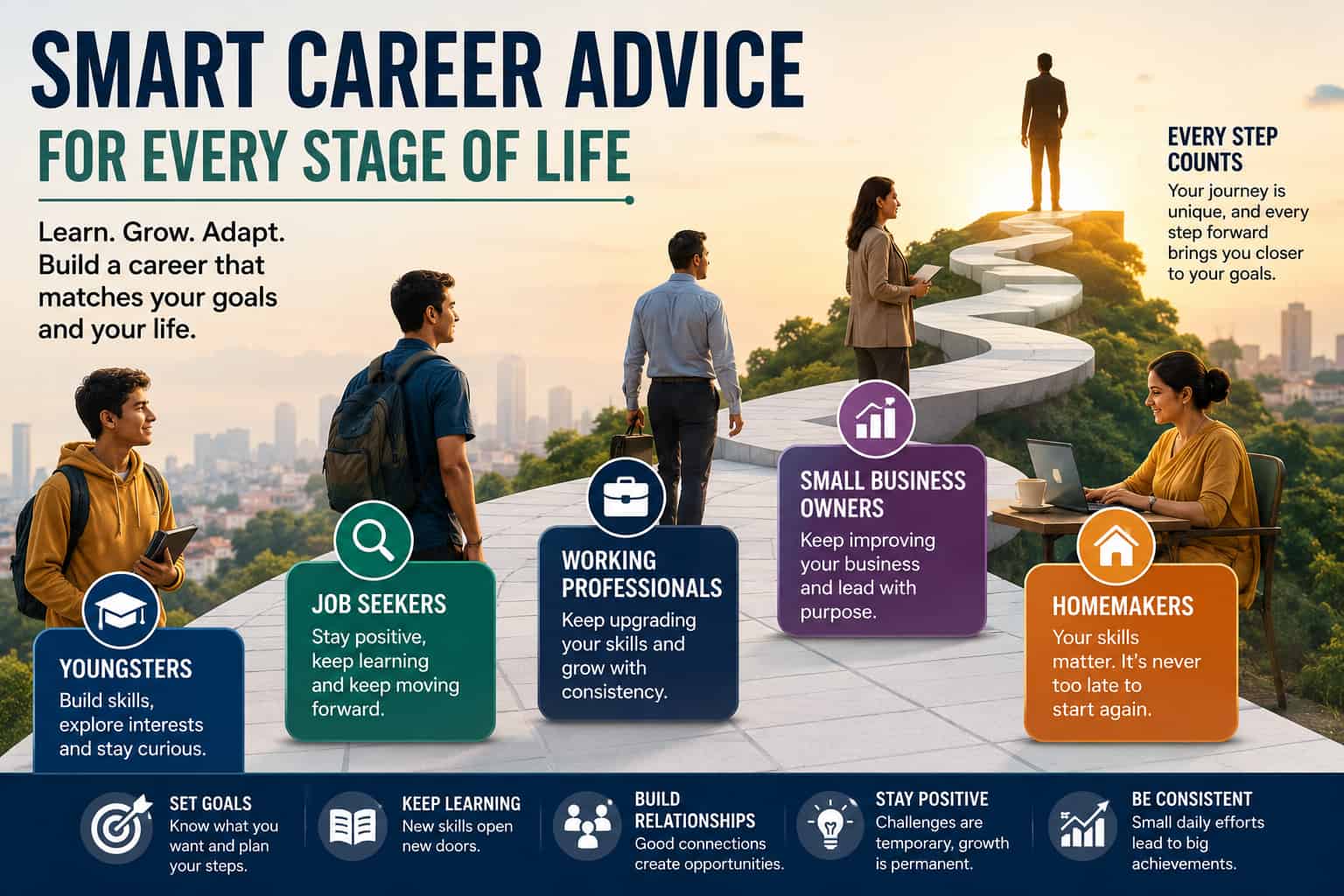
Smart Career Advice for Every Stage of Life
Careers rarely follow a straight path. Some people land a solid role at 21, while others are still figuring things out at 28. Someone might walk away from a stable job to start a business, while a homemaker might decide to return to the workforce after years of managing a household.
Wherever you are right now, you do not need to have the next decade mapped out today. You just need to know where you stand, decide what you want next, and follow smart career advice to take realistic steps forward.
Here are practical strategies for every stage of that journey.
Smart Career Advice: 10 Actionable Strategies
1. Stop Comparing Your Progress to Others
Comparing your career to someone else’s is a quick way to lose confidence.
Consider two college friends, Rahul and Amit. Rahul lands a job immediately and earns a comfortable salary by 24. Amit spends two years struggling to find steady work. On paper, Rahul looks like he is winning early on. But a few years later, Amit might end up running his own business, earning more, or working in a field he genuinely enjoys.
Careers are not timed races. Instead of asking, “Why am I behind?” ask yourself, “What skill can I improve this month?” That shift in focus keeps you moving forward.
2. Focus on One Practical Skill at a Time
A common mistake among job seekers is trying to learn everything at once. They sign up for courses in digital marketing, coding, graphic design, and finance all in the same month. Half a year later, they know a tiny bit about everything but cannot perform a single job with confidence.
Pick one clear, marketable skill and get good at it.
-
If you want an office role, master advanced Excel, basic data analysis, or clear written communication.
-
If you want to freelance, focus on content writing, website development, video editing, or bookkeeping.
Employers pay for specific, reliable skills, not a collection of unfinished courses.
3. Treat Unemployment as Preparation Time
Being out of work is stressful, but treat this period as active preparation rather than a dead end.
Instead of sending out hundreds of generic resumes every day and waiting, use that time to make yourself more valuable to an employer. Update your resume to focus on real outcomes, learn a software tool standard in your field, build a couple of small sample projects, and reach out directly to former colleagues or industry contacts.
The goal is not to stay busy for the sake of it, but to step into your next interview as a stronger candidate.
4. Make Your Resume Show Actual Results
A strong resume speaks clearly about what you can deliver. Too many people spend days tweaking fonts and margins while ignoring the substance of what they wrote.
Avoid vague bullet points like “Responsible for office work.” Instead, use clear, descriptive language: “Managed daily office records, prepared monthly performance reports, and handled direct client communication.”
The second version tells a hiring manager exactly what you are capable of handling on day one.
5. Keep Learning, Even When You Feel Secure
Landing a stable job is a milestone, but it is not the end of your professional growth.
Imagine working at the same company for eight years without updating your skill set. When the company adopts new software, a junior team member who picks it up quickly suddenly becomes the go-to person for key projects. Years of experience matter, but experience paired with outdated tools quickly loses its edge.
You do not need to study for hours every night. Spending just 30 minutes a day reading industry news or taking a targeted lesson keeps your knowledge relevant.
6. Treat Household Management as Real Experience
Career advice applies just as much to homemakers as it does to corporate employees. Running a home requires budgeting, scheduling, crisis management, and vendor negotiation. These are real, transferable skills.
If you are looking to restart your career after a break, start small. Look into online tutoring, remote customer support, bookkeeping, content creation, or running a small home-based service. The immediate goal does not need to be a massive paycheck; it is about rebuilding your professional confidence and gaining momentum.
7. Upskill to Fix Your Business Bottlenecks
Small business owners often spend so much time on daily operations that they neglect their own personal development.
A shop owner might excel at sales but struggle with accounting. A service provider might offer great quality but lack basic digital marketing skills. Identify the single biggest gap in your business operations and learn enough to handle it effectively. Improving your own capabilities often delivers a better return on investment than buying new equipment.
8. Build Relationships Before You Need Help
Reaching out to people only when you need a job feels transactional and uncomfortable.
Focus instead on maintaining genuine professional connections over time. Check in with former colleagues, stay in touch with classmates, acknowledge people’s accomplishments, and share useful articles or resources when you run into them. When you eventually need advice or an introduction, you will be reaching out to an established acquaintance rather than a stranger.
9. Focus on Action Over Motivation
Motivation is unreliable. If you wait until you feel completely ready or confident before applying for a job, reaching out to a client, or learning a tool, you might wait forever.
Confidence comes after action, not before. Keep momentum going with small, daily steps:
-
Update one section of your resume today.
-
Submit one well-tailored application.
-
Watch one instructional video.
-
Reach out to one contact.
Small, consistent steps build substantial progress over time.
10. Understand That Careers Can Always Be Redirected
It does not matter if you made a wrong turn earlier, spent years away from work, or watched a business venture fail. You are not locked into past decisions.
Your previous experience—even from completely different fields or non-traditional roles—has value. What matters now is identifying what you learned from those experiences and deciding your next move. It is never too late to adjust your trajectory.
Frequently Asked Questions About Smart Career Advice
How can I quickly start a career in digital marketing or web design as a beginner?
The most effective way is to skip theoretical tutorials and enroll in a practical digital marketing and web design training course. Working on live projects gives you a real-world portfolio, making it much easier to land your first job or acquire freelance clients.
What is the fastest way for job seekers to find genuine hiring opportunities?
Avoid clutter on general job portals by using verified job listings. These platforms connect skilled professionals directly with active employers who are looking for specific, job-ready skill sets.
How can small businesses get more leads without managing everything themselves?
Instead of spending months learning complex technical skills, business owners can hire expert digital marketing and web design services. Letting professionals handle site development and ad campaigns helps you generate consistent sales leads while focusing on running your business.
How do digital products speed up my daily work and career growth?
Using ready-made digital products—like premium resume templates, SEO roadmaps, proposal frameworks, and UI design kits—saves you hundreds of hours. You get to deliver high-quality, professional results to employers or clients in half the time.
Can guest posting really help in building brand authority and getting clients?
Absolutely. Utilizing a paid guest post service allows you to publish original content on well-established, high-traffic blogs. This boosts your search engine rankings, builds personal authority, and drives organic traffic to your services or portfolio.